
Cyprus’s EU presidency: European climate leadership in a hostile environment
As the current holder of the EU presidency, Cyprus has a rare opportunity to embed climate objectives into European policy discussions. Its leadership can have the greatest impact in important areas for the union, including environmental conditionality in the EU budget, housing stock renovation and capital flows to green projects.
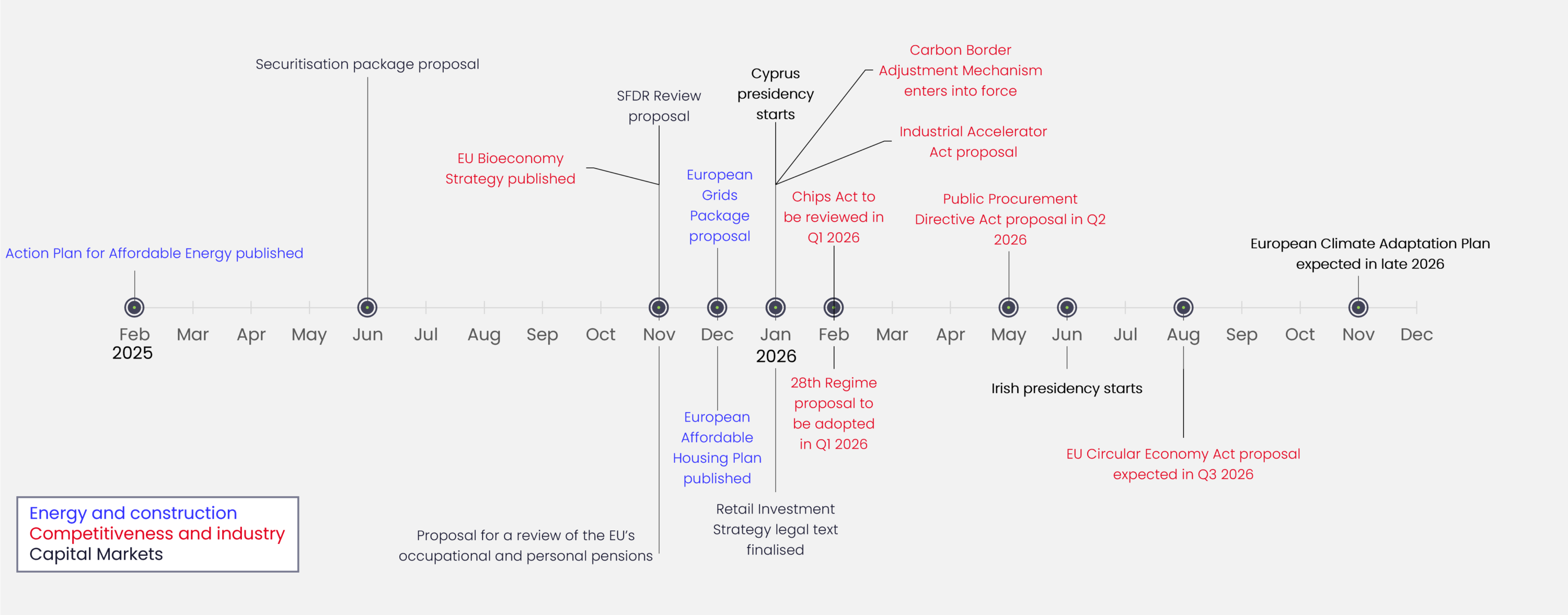
The European Union’s climate leadership is under growing pressure from the retreat of multilateralism and disruptions to the global economy. Cyprus’s six-month presidency of the Council of the EU, due to run until June 2026, comes at a time when many observers are questioning the credibility of European climate commitments, and the bloc is at a critical juncture in the development of its policy tools (see Figure 1). One of the most important roles Cyprus will play in this period relates to the 2028–2034 Multiannual Financial Framework (MFF) – which, as the EU’s next budget, will be central to climate policy and will deeply influence investment incentives and co-financing across Europe.
As a net recipient of EU funds, Cyprus is keenly aware of the EU’s transformative power. The country has placed European autonomy at the core of its presidency programme as a means to strengthen EU security, competitiveness and social cohesion, and to support the climate transition. Cyprus will have the chance to shape climate and environmental policy in upcoming discussions on at least three major areas: targets for environmental spending, housing affordability and capital markets development.
Figure 1. Pivotal moments for EU policy in the Cyprus presidency – full size version of Figure
Source: Author, based on policy initiatives flagged in Cyprus’s programme.
The presidency’s influence on EU negotiations
During its presidency, Cyprus will act as an intermediary between the 27 member states, bringing together ministers of national governments and leading negotiations between EU institutions. The role requires a degree of neutrality that will likely limit the country’s ability to push for its preferred policies. Nevertheless, Cyprus can exert influence in some areas: its intense focus on European autonomy – widely appealing in the current international environment – will allow it to drive initiatives on issues such as water resilience. While climate and environmental concerns are hardly the sole focus of its programme, Cyprus will have an opportunity to embed these issues in negotiations on the MFF and other policy discussions that are vital to EU resilience.
New spending targets in the next MFF
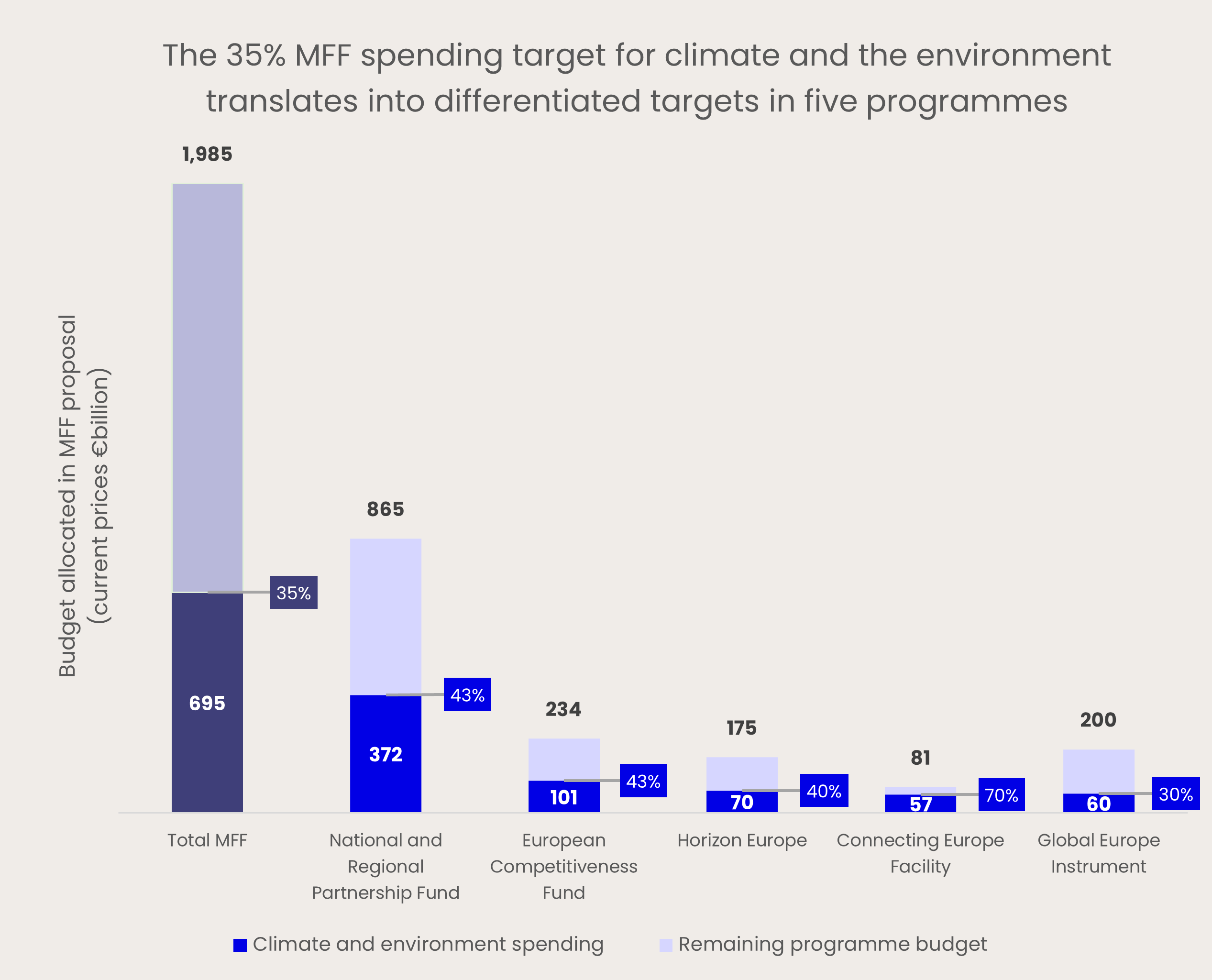
In July 2025, the European Commission proposed a new architecture that allocated 35% of the 2028–2034 MFF (between €660 billion and €700 billion in current prices) to climate and environmental measures such as climate change mitigation and adaptation. This will be deployed via programme-specific spending targets (see Figure 2), the highest of which is 70% of the Connecting Europe Facility, a financial instrument supporting the interconnectivity and interoperability of European transport, energy and digital infrastructure. Cyprus’s commitment to open dialogue, connections with smaller EU member states and emphasis on social cohesion could help it achieve its objective of reaching an agreement in negotiations on “indicative amounts” for the MFF (preliminary agreements for budget envelopes) and on “own resources” (revenue streams help finance the EU budget alongside national contributions).
Figure 2. Climate and environmental spending under the MFF, 2028-2034 – full size version of figure
Source: Author, based on European Commission(2025)
Cyprus aims to advance negotiations on the MFF using a performance-based approach inspired by the EU’s Recovery and Resilience Facility, which focuses on achieving certain results rather than on inputs and spending limits. In that regard, the presidency should pay particular attention to the robustness of new environmental spending targets. Potential pitfalls include:
- Defence and security exemptions from environment and climate spending targets. Every allocation to these sectors under the MFF will affect the budget base and could reduce such spending.
- The risk of overestimating the impact of a budgetary intervention on the EU’s climate and environment initiatives.
- Inaccurate classification of some activities as climate or environmental spending.
Affordable housing priorities
Affordable housing is at the top of the EU’s agenda. Between 2013 and 2024, nominal house prices in the EU rose by more than 60% and rents by around 20%. The appointment of a commissioner for housing and the European Commission’s publication of the European Affordable Housing Plan in December 2025 have created momentum to increase housing supply and trigger reform and investment in the sector. Cyprus has followed suit by describing housing as a cross-cutting priority – and, within this, underlining the importance of energy efficiency. The EU will need to balance greenhouse gas emissions linked to new housing against cost-efficient building renovation without compromising on its environmental objectives.
However, housing is primarily a national competency that is connected to various EU policy areas – namely: energy, social cohesion and climate. As such, Cyprus will use the presidency to weigh in on the general direction of travel rather than implementation: it will organise an Informal Ministerial Conference on Housing in May 2026, but will not touch on ongoing EU reforms for the renovation of buildings that are vital to providing affordable housing in the long run and require coordination.
While Cyprus’s position reflects the complex institutional oversight of housing policy in the EU, there is a risk that its approach will fail to provide the political leadership needed to ensure the success of the bloc’s renovation strategy. This is a particularly relevant concern for the National Building Renovation Plans, which sit outside the presidency programme and will serve as member states’ roadmaps to decarbonise building stocks once they have been finalised by the end of this year.
Savings and investment
Cyprus’s prioritisation of the EU’s Savings and Investments Union (SIU) could open new avenues for investment in the net-zero transition. The SIU might provide the last opportunity to move towards an integrated EU capital market: the bloc has made little progress on this issue in the last decade, but external pressure is now pushing member states towards alignment on European financial autonomy. Presented by the Commission in March 2025, the SIU focuses on enabling the integration of the financial system, creating new savings and investment products, and leveraging private finance to help the EU achieve its strategic objectives. The advent of the SIU also creates a much-needed opportunity to integrate climate considerations into various segments of capital markets.
Cyprus intends to advance legislative work on the SIU, viewing it as essential to the EU’s competitiveness and financial autonomy. The country is in a strong position to include smaller economies in the effort, notably by supporting work on a transparent securitisation market, which would promote investor protection and simplify access. It has underlined its commitment to supporting small and medium-sized enterprises, as well as retail investors, and aims to finalise technical work on the Retail Investment Strategy. In this regard, the EU’s occupational and personal pensions review could help pension funds increase sustainable investment.
However, the presidency’s overall focus is on finding opportunities for financial markets to promote the EU’s strategic independence rather than its climate policy. The fast-approaching Sustainable Finance Disclosure Regulation review, which Cyprus has prioritised, may provide a telling example of this if it weakens the requirements for participants in financial markets to disclose sustainability risks.
Turning milestones into momentum: opportunities for climate policy
Beyond its role in the budget, housing reform and capital markets, Cyprus will monitor the implementation of the carbon border adjustment mechanism (CBAM)and help advance negotiations on the EU’s Bioeconomy Strategy and European Climate Adaptation Plan. To embed EU climate objectives into the dense 2026 agenda, the country should carefully engage with the following policy discussions:
- A strengthened environmental conditionality in the MFF: in line with the ‘do no significant harm’ principle, the EU should avoid funding measures that significantly damage efforts to achieve the six environmental objectives of its Taxonomy Regulation. Cyprus should ensure that the principle is consistently applied to all aspects of the new MFF and limit planned exceptions – such as those for defence and security.
- Joint debt issuance: while this is politically infeasible in the next MFF, the Recovery and Resilience Facility set a precedent for joint EU borrowing and has greatly influenced the EU’s fiscal architecture. There is now an opening to create joint financing instruments linked to EU priorities such as climate resilience alongside the MFF.
- Efficient housing stock renovation: affordability objectives have sometimes resulted in fiscally inefficient and not-so-green subsidies. To ensure that fiscal incentives sustainably reduce costs and decarbonise housing, the Commission and member states should design policies that promote targeted renovations as well as price subsidies, while supporting uptake by lower-income households.
- Capital flows to green projects: the SIU’s aim to mobilise capital to fund the net zero transition would be best served by creating green, pan-European retail saving products and enhancing efforts to develop an EU green securitisation market.
By guiding discussions on all these areas, Cyprus can strengthen much-needed EU leadership and action on climate resilience in a fragmented world.
The author would like to thank Agnieszka Smolenska, Sini Matikainen, Chris Raggett and Georgina Kyriacou for reviewing an earlier draft of this commentary.